Field Note
AI Is a Delegate-Tier Solution. Most of Your Problems Aren't.
A pre-AI operations filter that decides what AI is actually for. Run every candidate through Eliminate, then Automate, then Delegate — in that order — before evaluating any tool.
The Wrong Question
Someone in the meeting says it: “we need to add AI to X.” Reports, intake forms, follow-ups, scheduling, the inbox — everything is a candidate. The conversation moves immediately to which model, which vendor, which integration.
That’s the wrong question. Or rather, it’s the third question being asked first.
The right sequence is older than this AI popularity cycle. I’ve used it for years, with clients, at previous positions, and on my own work, long before LLMs made the third tier cheap. The framework didn’t change. AI just collapsed the cost of the last step so dramatically that operators forgot the first two steps existed.
The filter is EAD: Eliminate, Automate, Delegate. In that order.
The Filter
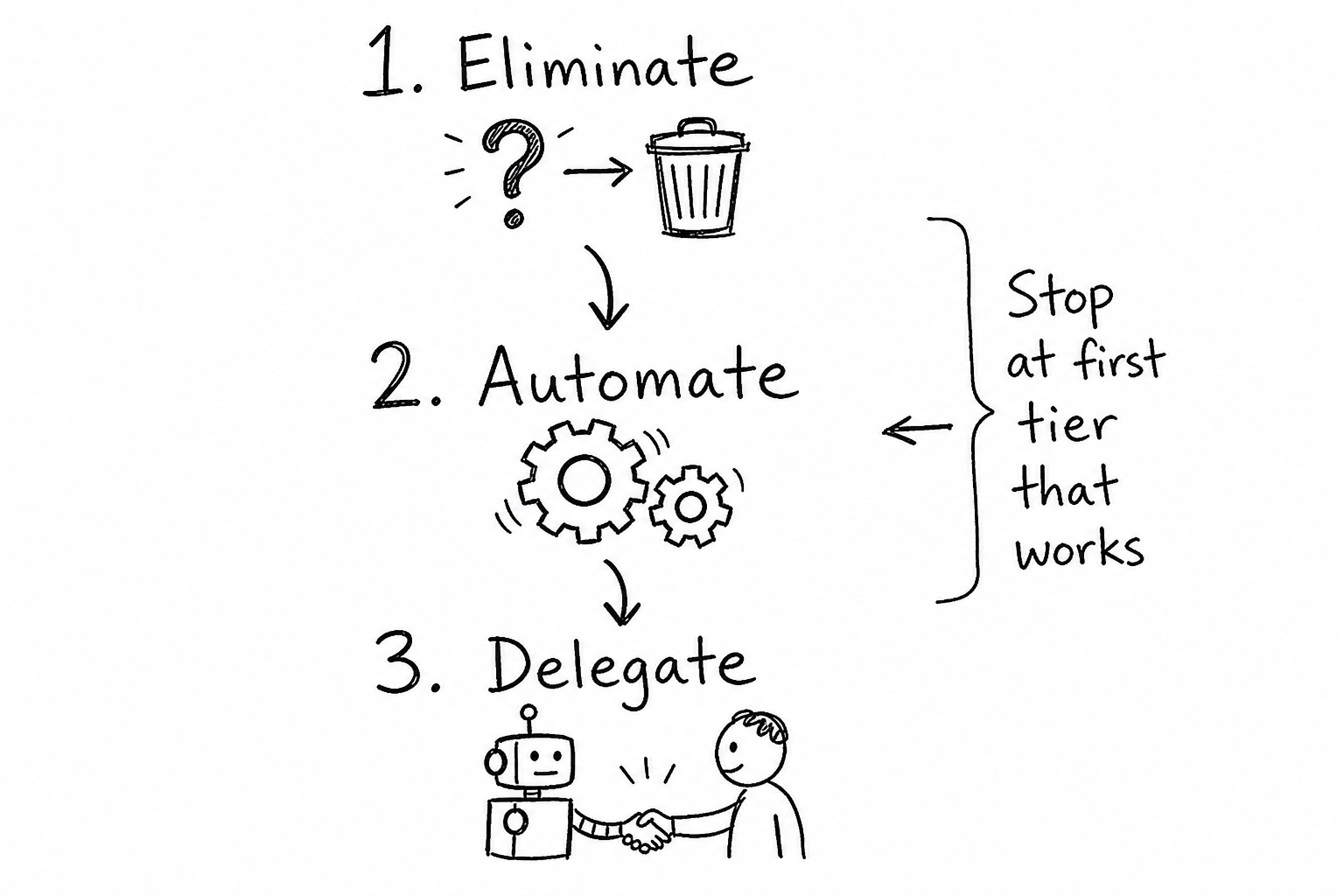
Three tiers. Run every candidate process through them sequentially. Stop at the first one that resolves the problem.
1. Eliminate. Does this work need to happen at all? Who is asking for it, and what breaks if it stops? Most operational pain is work that compounded without anyone re-asking why. Reports, status meetings, fields on a form, approval steps — a meaningful share of what runs inside a $1M–$10M business is residue from a decision someone made when the company was a third its current size.
(Myself for example: I built a full suite, a wiki, employee logins, authentication portals, client onboarding, etc… 1/5 of it was being used. I got so hung up on the AI and automation portions, we just kept layering in new tools and with each addition, more workload, more tech debt, and less people to oversee any of the results. I myself had to stop and evaluate what we were, what we had built or installed. Every tool we had added for 2 years was intended to assist, improve, speed up, and more. Once I ran back through this same framework, focussing hard on the elimination step: we saved ~15hrs a week in system maintenance and lost 0 productivity or clients.)
2. Automate. If the work has to happen, can a deterministic rule do it without judgment? A schedule, a template, a webhook, a stored procedure, a Zapier-tier integration. Things that don’t drift. Things that produce the same output every time given the same input.
(Notes: I have found that too many companies forgot how they managed to get where they are already. The race to put “AI” in their budget, name, website, integration plan, or board updates, has replaced basic thinking steps. A simple question: “Can this process be automated without the use of a judgment step?” If so, then why add AI to it?)
3. Delegate. If judgment is required, who gets it? A human with authority and accountability — or an AI with guardrails, defined inputs, and a review checkpoint? Both are real options. Both have costs. Pick deliberately.
The order is the filter.
Skipping ahead is the failure mode.
Most “AI integrations” I see in the wild are step-3 answers to step-1 questions.
(Important: A computer cannot be held liable. So if judgment is needed, and you move to an AI system, ensure the judgment call is not “Permanent.”)
Why AI Breaks the Filter
The structural problem is that the AI pitch is a Delegate-tier pitch. Every demo, every vendor deck, every “look how this agent handles your inbox” video assumes the work should happen and that judgment is required. They sell the third tier because that’s where their product lives.
Vendors don’t sell Eliminate. There is no SaaS for “stop doing this.” There is no growth-stage startup whose roadmap is “convince our customers to delete a workflow.” The AI ecosystem has a structural bias toward keeping work alive.
It gets worse when the demo is cheap. A plausible Delegate-tier solution can be stood up in an afternoon — slap a wrapper around a model, wire in a handful of tools, point it at a Slack channel. The operator sees the result before anyone asks whether the underlying work survives audit. By the time the question gets asked, there’s a statement of work, an integration, and a quarterly recurring cost.
Three failure patterns I’ve watched land:
-
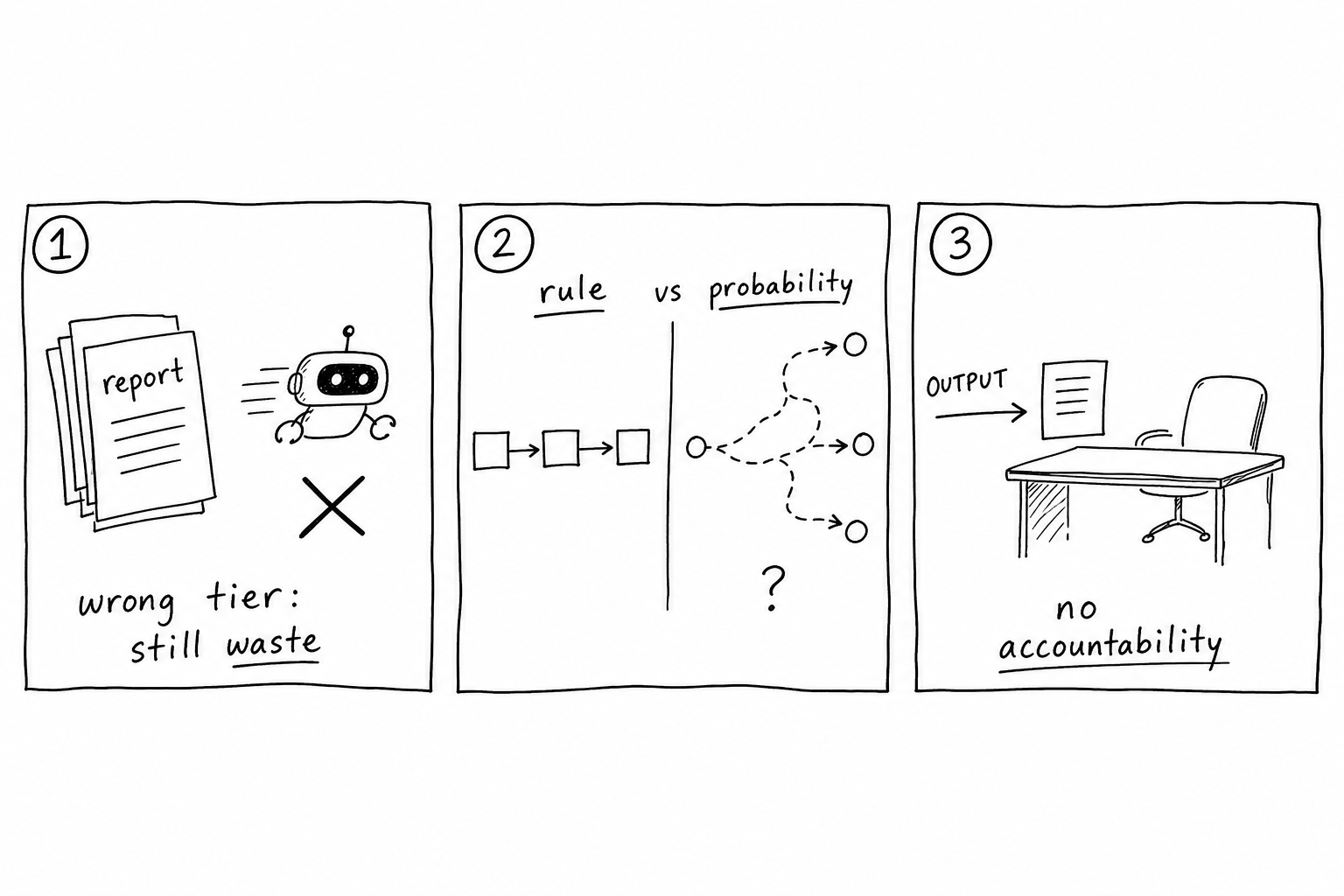
Eliminate-tier work given to AI. AI now produces the report nobody reads, faster. The hours saved aren’t real savings — they were already wasted. The integration adds cost on top of waste.
-
Automate-tier work given to AI. A $0 deterministic rule becomes a $200/month agent. Worse: the rule was reliable. The agent occasionally hallucinates a routing decision, and now the team is debugging non-determinism in a problem that didn’t have any. If all your business needs is a form automation step, why include AI in the process…? That is a basic sequence. If you must use AI, use it to build the automation, don’t include it in the loop any further than it should be.
-
Delegate-tier work given to AI without review. Judgment work shipped to a model with no accountability surface. When something goes wrong, a misrouted refund, a wrong follow-up, a confidently incorrect summary sent to a client. There is no person to ask, no decision log, no place where responsibility lands. So where does it land? On your revenue sheet.
Three Worked Examples
Three realistic requests, run through the filter. The pattern repeats; the inputs change.
Filter resolved at step 1. Eliminate:
“Add AI to our weekly status report.” The report goes to four people. Two skim it. One doesn’t open it. The fourth, the person who originally asked for it, left the company eight months ago. The report exists because it has always existed. Killing it saves more time than any AI summary would, and removes a meeting whose existence depends on it.
Filter resolved at step 2. Automate:
“Use AI to route incoming form submissions.” The form has a dropdown. The dropdown has six values. Each value maps deterministically to one of three teams. A twelve-line rule does it perfectly, every time, free, with no failure mode that isn’t trivial to debug. Adding AI here replaces a deterministic problem with a probabilistic one.
Filter resolved at step 3. Delegate, conditionally:
“AI-assisted first-draft client deliverable.” This one survives the filter: drafting is judgment work, the volume is real, and the inputs are bounded. But it only works after a documented template exists, and a reviewer is named, and a checkpoint is built into the process before anything ships. Without those, you’re not delegating to an AI, you’re handing judgment to an entity with no accountability surface, and hoping.
I’ll go one step further, you can build the template with AI, and judge with AI, and hand-off with AI. If it’s a non-permanent decision. If the AI gets it wrong, can you recover?
If yes, use AI more in this step. If the answer is no, then somewhere there must be a human who can be accountable.
The Eisenhower Overlay
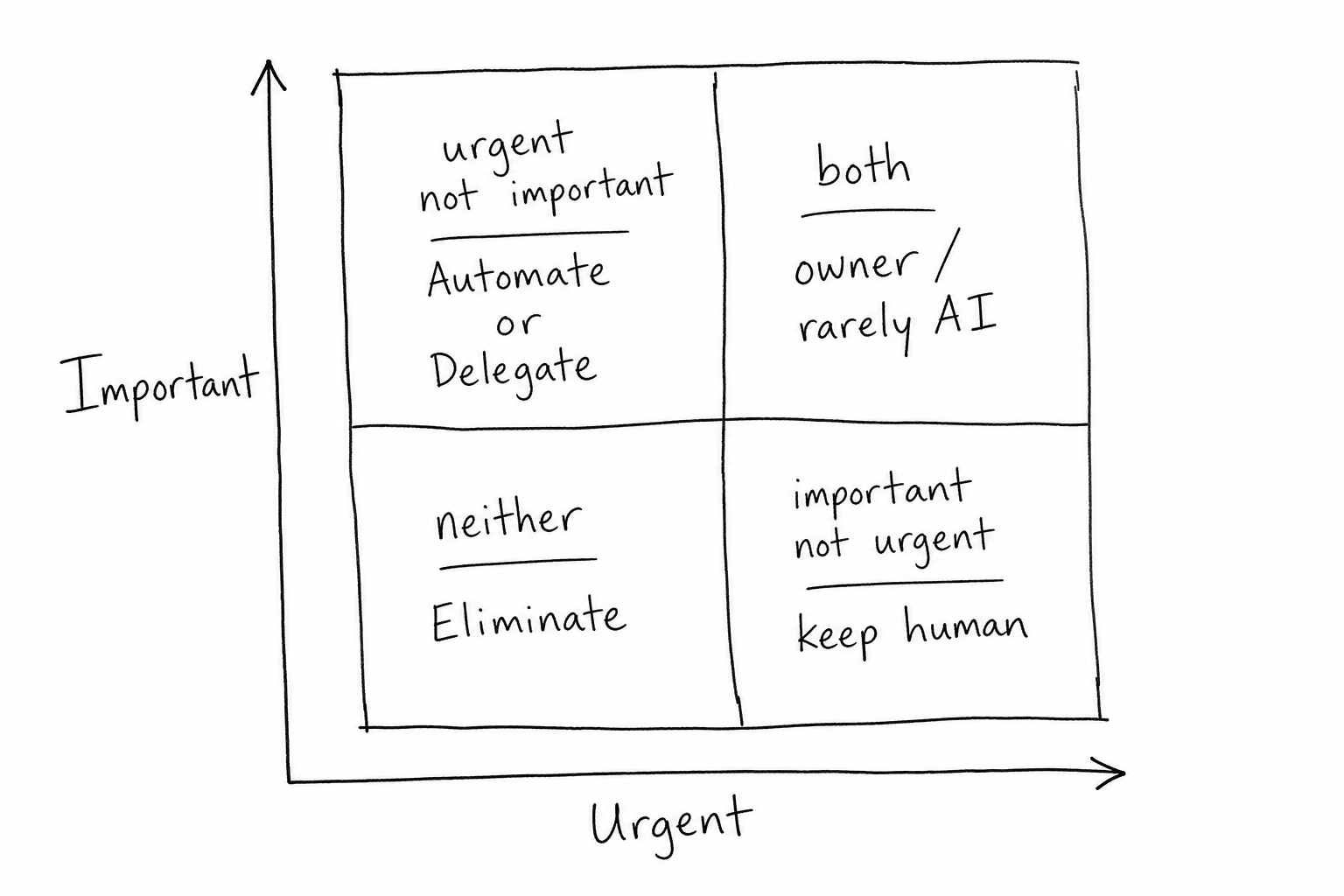
A short sidebar: the urgent/important grid. Every client engagement I enter around this subject, I make them draw this out. I don’t hand it to them, I don’t print a picture, I ask them to actually draw it out while I walk through it with them. I used to give it to employees, then clients. I have found that drawing it out and filling it in, has a higher impact. You can do it right now, from the image below.
Map EAD to the matrix:
- Neither urgent nor important → Eliminate.
- Urgent, not important → Automate or Delegate.
- Important, not urgent → Strategic. Usually keeps human attention.
- Urgent and important → Owner-tier. Rarely AI-eligible.
Most “AI candidates” land in the Urgent-not-Important quadrant. That’s the tell. They’re work the owner shouldn’t have been doing in the first place. It’s work that drifted into the calendar because it was loud, not because it was load-bearing. AI doesn’t fix that. The matrix already did.
Where This Hits
Different operators feel this in different ways.
If you run a services business: the AI candidates that survive EAD are usually deliverable assembly, intake summarization, and follow-up drafting. Bounded inputs, repeatable structure, judgment that compresses well into a template. Strategy doesn’t survive. Pricing doesn’t survive. Client judgment doesn’t survive. Anything that requires reading the room, or reading between what the client said and what they meant, is not a Delegate-tier problem.
If you run an internal ops team: most AI requests coming up from your team are Eliminate or Automate questions wearing a Delegate costume. The team is asking for AI because that’s the framing they’ve been trained to use. Send the request back through the filter before approving spend. “What gets eliminated if this works?” answered honestly will resolve more requests than the budget will.
If you’re evaluating vendors: ask the salesperson, on the call, what work gets eliminated when their tool succeeds. Most can’t answer. The ones who can are worth a second meeting. The ones who pivot to “more capacity” or “scaling your team” are selling the third tier as a substitute for thinking about the first.
The Do’s and Don’ts
Don’t
- Don’t evaluate AI tools before auditing the underlying process. The tool is the answer to a question you haven’t asked yet.
- Don’t skip Eliminate just because the work has always been done. Tradition is not a requirements document. “Always” is when the audit matters most.
- Don’t use AI for deterministic problems. A rule is cheaper, more reliable, and doesn’t drift. Probability is not an upgrade over certainty.
- Don’t measure success in “hours saved” without asking whether the saved hours were producing value. Faster waste is still waste.
Do
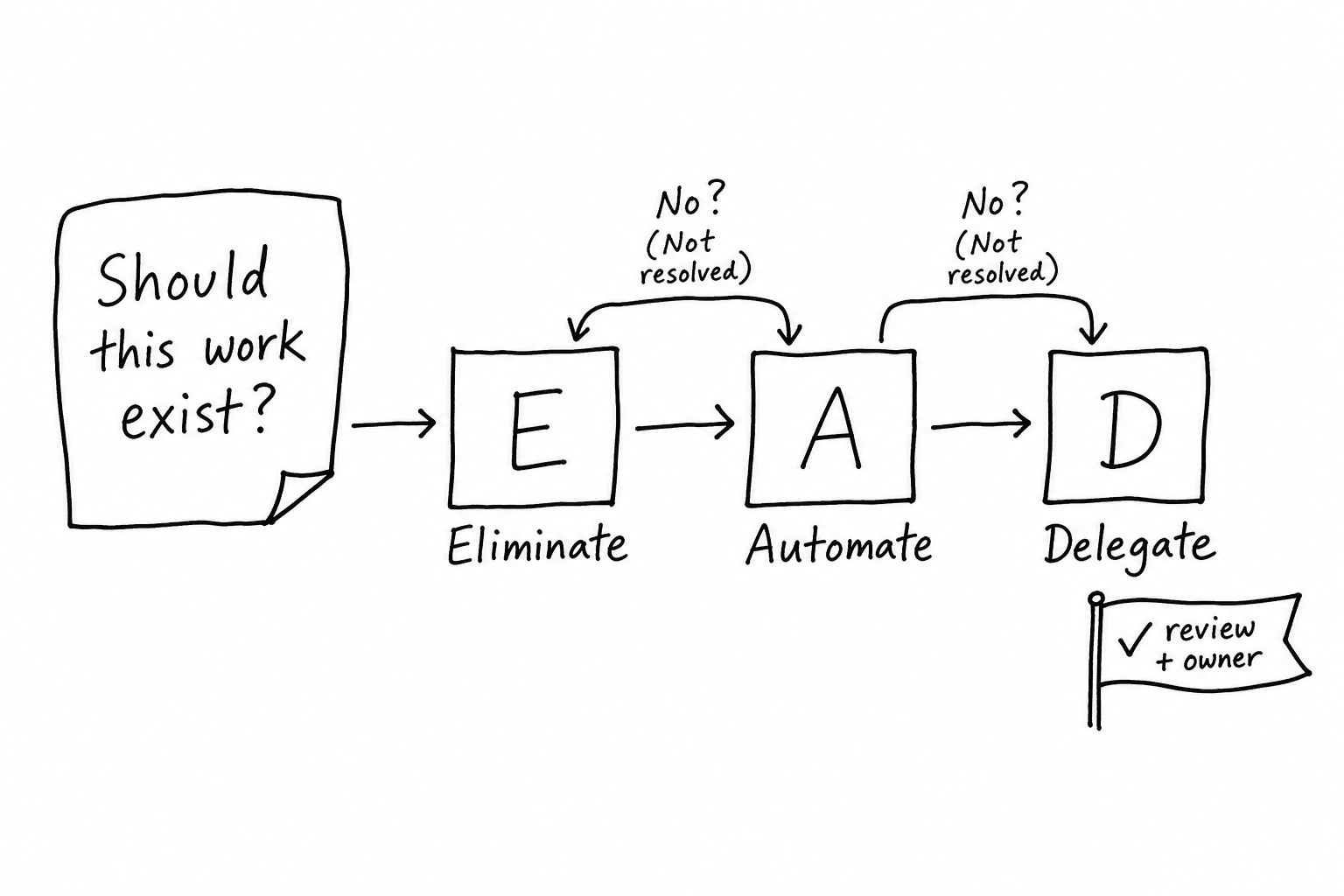
- Run candidates through E → A → D in order. Stop at the first tier that resolves the problem. Most stop at one or two.
- Document what gets eliminated if the AI integration succeeds. If the answer is “nothing,” reconsider. The integration may be real, but the framing isn’t.
- Pair every Delegate-tier AI deployment with a review checkpoint and a named accountability surface. No reviewer, no deploy.
- Re-audit annually. AI capability shifts. Today’s Eliminate candidate might genuinely be next year’s Automate candidate. Run the filter again.
The Point
AI is a Delegate-tier solution. Most operational pain is not a Delegate-tier problem.
The framework didn’t need updating for AI. What changed is how cheap the third tier became, and how easy it became to skip the first two. Vendors will keep selling Delegate-tier answers because that’s the product they have. Your job as the operator is to ask the question they don’t: should this work exist at all?
This sits next to a few other posts on this site that get at the same root from different angles. Intent over capability on asking “should I” before “can I.” What not to build on the same question pointed at the build phase. AI risk: field observations on what AI tools actually do once they’re in the stack. Determinative ideation on the related dynamic where AI gives you back the answer you were already steering toward — the same pattern vendors run when they sell you the tier their product lives in. They share a center: the most useful filter in any operation is the one applied earliest, before tooling, before vendors, before spend.
If you take one thing from this: before “which model,” ask “should this work exist?”
That single question, asked honestly, at the front of every AI conversation that lands on your desk, will resolve more candidates than any vendor evaluation matrix you can build.
Your business doesn’t need more tools. It needs better decisions about the tools it already has.